Introduction
It is almost impossible to reconcile the ordinary calm of the final night with the fact that it ended in loss. The lights rose. Fans filled the seats. The band began to play. And Conway Twitty, whose voice had carried a lifetime of longing and tenderness, walked onto the stage and gave himself to the music in the same wholehearted way he always did.
On June 4, 1993 he performed for a sold out audience at the Jim Stafford Theatre in Branson, Missouri. For those in attendance it felt like another special evening with a living legend. Conway Twitty had a way of making each song sound like it was addressed to a single listener. That night he sang with the warmth, the strength, and the quiet authority that had won him a place in the hearts of country fans.
When the show concluded the crowd cheered for an encore that everyone assumed would come another night. The house lights dimmed and the curtain fell. Conway Twitty left the stage after doing what had defined him for decades, singing straight from his heart to the people who came to hear him.
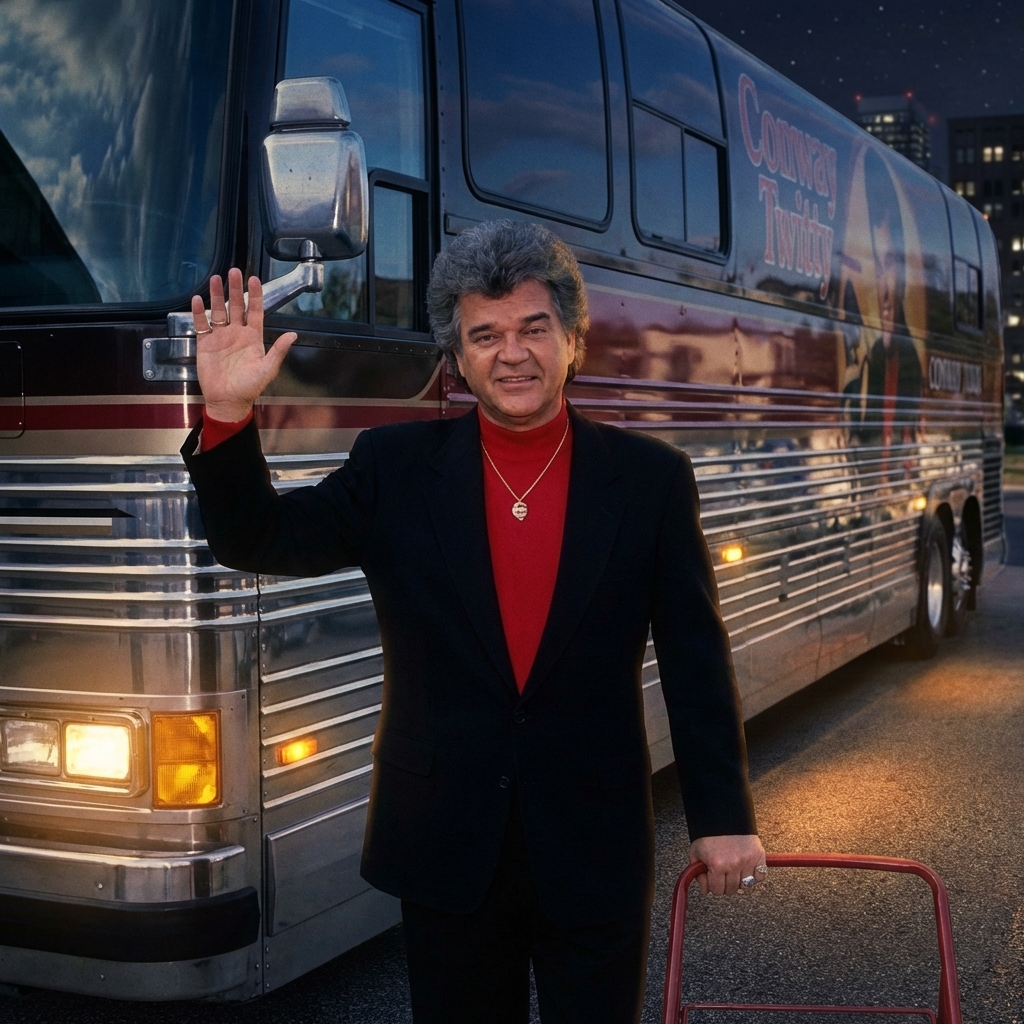
A quiet road trip home should have followed. The tour bus departed Branson heading toward Nashville where Fan Fair was next on the calendar. It was meant to be one more routine stretch of highway for a performer accustomed to the rhythm of the road. The energy from the concert still hung in the air and the next stop was already waiting.
Somewhere near Springfield, Missouri the night changed in an instant. Inside the bus Conway Twitty suddenly fell ill. What had been a triumphant evening turned into a moment of alarm and confusion. Band members and companions rushed to help as he collapsed. The driver steered toward Cox South Hospital while those around him hoped the hospital would arrive in time.
In situations like this the image of public figures becomes sharply human. Onstage he had been commanding and composed. Offstage in those last hours he was a husband, a father, a friend, and a man whose life had been built one song and one mile at a time. The performance lights no longer defined him. He was simply a person facing a sudden crisis.
By the morning of June 5, 1993 Conway Twitty had passed away at the age of 59. The news struck many as particularly painful because the end came so soon after a night that had seemed so ordinary. He had just stood before a packed theater and shared the music he loved. There was no farewell on that stage, no warning to prepare for goodbye. There was only his voice and then silence.
The legacy he left extended far beyond a list of hits. Conway Twitty left songs that keep company with people during lonely nights, long drives, and moments of heartache. He sang about love as if he had lived it, and he sang about pain without looking away from it. He understood that the truest country music does more than entertain, it sits with people and helps them feel understood.
Even when the last curtain fell, his music continued to speak for him. The idea that he was onstage doing what he loved just two hours before his death is profoundly moving. He did not step back from the life he had built. He showed up to his craft until the end.
Perhaps that is why the story endures. It is not only that his life ended too soon. It is that he lived fully up to the very thing he loved most. The highway outside Springfield grew quiet long ago and the lights at the Jim Stafford Theatre are dimmed. Yet the songs he left behind still travel, still find new listeners, and still remind people that some voices do not truly disappear when the night ends.
Conway Twitty was gone by morning, but the echo of his final performance has never fully faded.
Video