Introduction
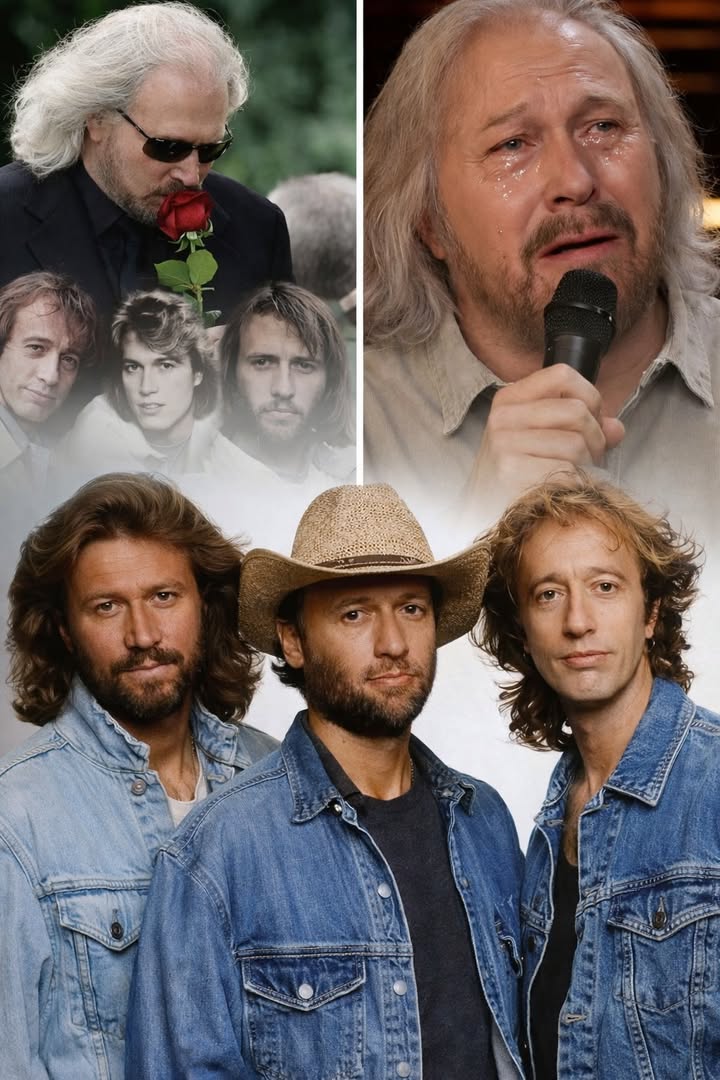
Barry Gibb made no speech. He did not raise his voice to rally an audience. He stood beneath soft stage lights and let a plain human response appear. Tears fell without rehearsal, without pretense, and in that silent instant more was conveyed than any prepared tribute could express. The scene was less a concerted homage than a quiet handoff of a cultural torch across generations.
Barry Gibb has always been more than a singer. Together with his brothers Robin and Maurice he helped craft a sound that became the backdrop to countless private and public moments. Their music was built on layered harmonies and fragile, soaring lines. Yet on this evening, without words or music, Barry demonstrated that a legacy does not require proclamation to exist, it simply persists.
This was not an exercise in fond remembrance. It avoided the soft glow of nostalgia. Instead it felt like movement, alive and plain, proof that influence can transfer while still breathing.
The atmosphere held no loud announcements and no rundown of chart positions. Those present needed no reminder of the hits. The moment carried an unspoken understanding that the Bee Gees’ effect was never only about sales figures. The true power of their work lay in how it had lodged itself inside people’s lives. Barry’s stillness, and the single tear on his cheek, spoke plainly that history is a presence to be felt, not merely a list to be recited.
For witnesses the scene pierced through manufactured emotion. In a world where feeling is often staged, his silence acted as a corrective. It was not absence of feeling. It was recognition. Recognition of brothers gone. Recognition of decades of song. And recognition that something larger was continuing beyond any one performer.
What followed did not descend into imitation. Emerging performers took their turns, but they offered their own readings, not carbon copies. That distinction mattered. When music shifts from mimicry to reinterpretation it takes on new life. The Bee Gees’ catalog stopped being an object to be preserved behind glass. It became active, adaptable, inhabiting new voices and fresh perspectives.
These artists did more than sing familiar melodies. They accepted responsibility. The songs did not shrink under their hands. Instead they grew, proving that the work could travel beyond its original creators and remain vital. This was not about keeping a small flame alive. It was about passing the spark so others could light new fires.
To honor the past is one thing. To let the past move forward with you is another. The night felt less like a farewell and more like a commissioning.
Observers described the room not as a place of spectacle, but as something almost reverent. There was a shared sense that everyone present was witnessing a turning point. Barry’s tears were not a sign of weakness. They were a sign of comprehension. He recognized that the music he helped build had expanded beyond his personal role and would carry on without him at the helm.
The occasion clarified the difference between an ending and a continuation. Endings can separate and contain. Continuations broaden and connect. Barry did not close a book. He released text back into public life so it could keep working, changing, and inspiring. The legacy was not put away. It was entrusted to a wider audience.
Context deepens the meaning of that instant. Barry Gibb is the oldest of the three brothers and now the only surviving member of the group. His life in music spans more than fifty years and maps onto decades of cultural shifts that few artists have navigated while remaining relevant. He was born in 1946 on the Isle of Man and his family later moved to Australia, where the brothers began performing locally long before global success arrived.
The group first found international attention in the late 1960s and then became global superstars during the disco era of the late 1970s. Songs such as Stayin’ Alive, How Deep Is Your Love, and Night Fever soundtracked films and dance floors around the world. Those tracks are more than chart entries. They are cultural anchors embedded in many people’s memories and private stories.
Financial estimates reflect the lasting commercial value of the catalog. Analysts point to income from licensing, catalog sales, and rights management, placing Barry’s net worth in the tens of millions. Those numbers show not only past success, but the ongoing market for these songs.
It is easy to fixate on awards and sales. Yet Barry’s quiet moment shifts the measure of importance. Legacy is not only trophies on a shelf or airplay statistics. It is what continues when the original voice is no longer central. It is what adapts and finds new listeners.
When Barry raised his eyes, damp but steady, he displayed a simple determination. He trusted the music, the audiences, and the younger performers who accepted the task of carrying it forward. The songs were not handed down as relics. They were given as living material meant to evolve and to be used.
That trust is the deepest music of all.